
By Sion Dettra
Founder & Editor, The Grand Touring Journal
Every time I open social media, I am greeted by another karting prodigy. The child is six years old. He has sponsors. He has a driver coach. He has a nutrition coach. He has a simulator. He has a social media manager. He apparently has a five-year development plan aimed at Formula One.
At six.
When I was six, my primary motorsport achievement was successfully making race car noises sitting on my bed gripping a LP record like a steering wheel.
Needless to say, our racing careers got off to somewhat different starts.
Modern motorsport has become obsessed with youth. Every week there seems to be another headline about a teenage sensation signing a professional contract or a Formula One prospect who isn’t old enough to drive himself to the racetrack.
Some begin karting before they lose their baby teeth. Some enter professional racing before they have a driver’s license.
Watching all of this can create the impression that if you weren’t identified as the next racing superstar by age ten, your opportunity has come and gone.
Fortunately, club racing couldn’t care less.
The local paddock will unlikely ask for your kindergarten racing résumé. And that’s a good thing. Because like many enthusiasts, my path to racing wasn’t exactly linear.
To be clear, this isn’t the story of someone discovering motorsport late in life. I raced quarter midgets that I was too heavy for, thus never competitive. My parents were supportive, but somehow never suggested mortgaging the family home to launch an international karting campaign.
I’ve driven race cars. I’ve spent time on racetracks. I’ve participated in track events. I’ve experienced enough speed to know that racing is considerably harder than it looks from the grandstands. What I never had was the opportunity to pursue it seriously.
Like many enthusiasts, I spent most of my adult life focused on other priorities. Serving in the military. Going to school. Starting a career. Raising a family. Paying mortgages. Paying taxes. Doing all the things responsible adults are generally expected to do.
Racing existed somewhere in the background. Always present. Always interesting. Never quite within reach. The challenge wasn’t a lack of passion. The challenge was time, money, and opportunity. Those three things have ended more racing careers than blown engines.
I became what many of us become. An expert spectator. I attended races. I read magazines. I watched Formula One, IndyCar, IMSA, and endurance racing. I convinced myself that actual racing was something other people did. The professionals. The wealthy. The lucky few who started at age five and spent their childhood circling kart tracks while the rest of us were learning basic math.
Then something interesting happened. I got older. And I started paying attention to who was actually racing. Not on television. Not at Monaco. Not at Indianapolis.
At local race tracks. The drivers weren’t all twenty years old. Many weren’t even particularly young. Some were in their fifties. Some were in their sixties and some well beyond.
Not reminiscing about their glory days of racing, but actively doing it.
At that point, I began to suspect that perhaps the expiration date on my own racing ambitions had been greatly exaggerated. The truth is that amateur motorsport may be one of the few competitive pursuits where age can actually bring advantages.
Experience matters. Patience matters. Mechanical sympathy matters. The ability to stay calm when things go wrong matters. Young drivers have lightning-fast reflexes.
Older drivers have something equally valuable. A healthy appreciation for consequences.
At twenty years old, your racing strategy is often:
“Full send.”
At fifty-five, your strategy becomes:
“Let’s try not to create paperwork.”
This turns out to be surprisingly effective. The older I get, the more I appreciate the wonderful absurdity of local club racing. Walk through any paddock and you’ll find engineers, business owners, mechanics, retirees, military veterans, doctors, teachers, and every other profession imaginable. You’ll find people discussing tire pressures while simultaneously comparing cholesterol medication. You’ll find drivers debating brake bias while adjusting reading glasses. You’ll find more knee braces than sponsorship decals.
And you’ll quickly discover that nobody seems particularly interested in acting their age.
Thank goodness.
Because acting your age is overrated.
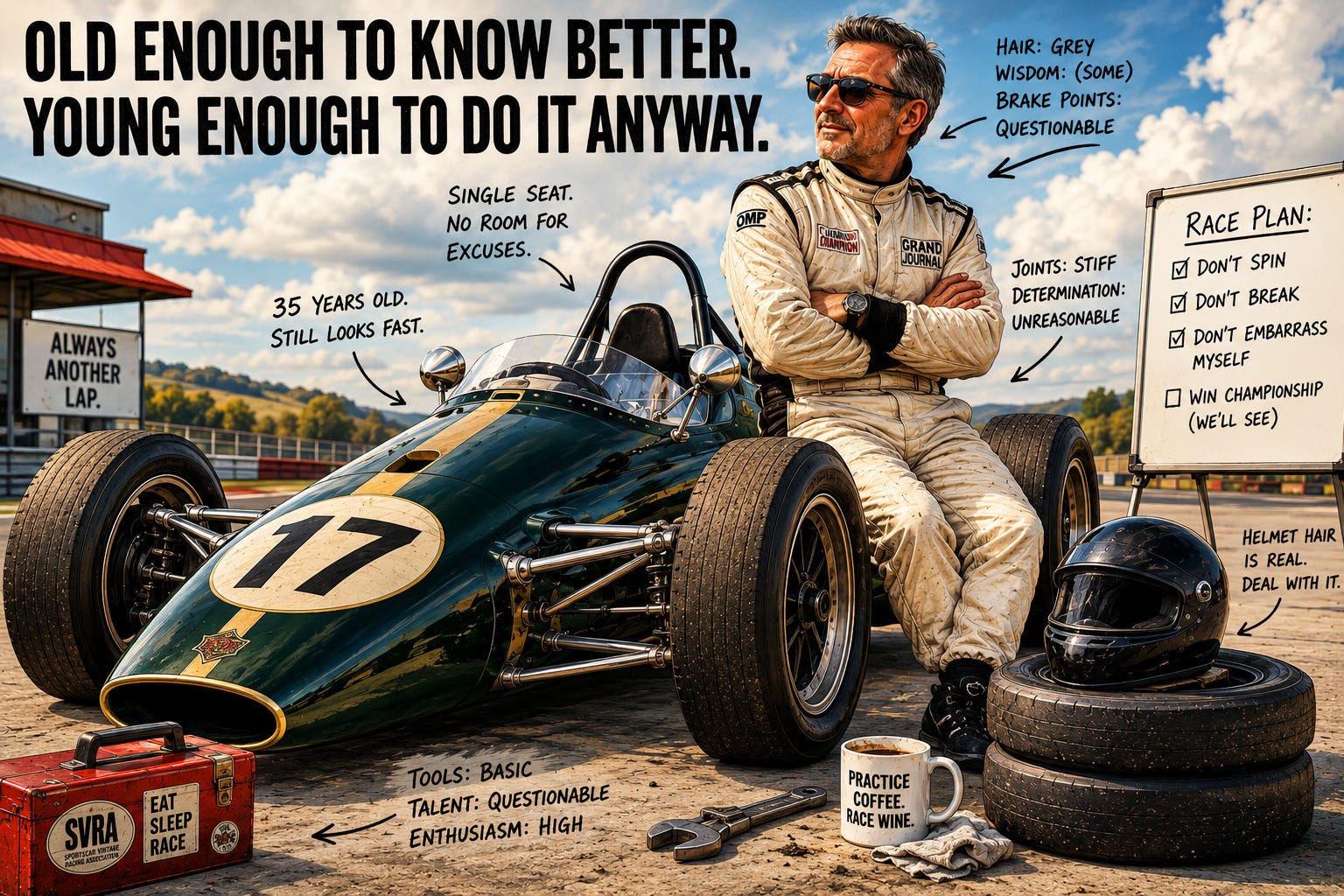
As I write this, there is a thirty-five-year-old Formula Continental race car sitting in my garage. If we’re being completely honest, purchasing a vintage open-wheel race car at this stage of life was probably not the most practical financial decision I have ever made. Somewhere, a financial advisor is reading this and quietly shaking his head.
Yet every time I walk into the garage, I smile. Not because I expect to become the next Mario Andretti. That ship sailed decades ago. Probably around the same time I was figuring out how to pay rent.
What matters is something much simpler. For the first time in my life, racing feels possible. Not professional racing. Not sponsorship deals. Not championships. Just racing. The opportunity to become the racer I never really had the chance to become thirty years ago.
And perhaps that’s what I admire most about the older racers I meet. Every one of them represents a quiet refusal to surrender a dream simply because society believes certain activities belong to younger people.
The green flag doesn’t care how old you are. The stopwatch doesn’t care how old you are. The race car certainly doesn’t care how old you are. It only asks whether you’re willing to climb in and give it a try.
After all, most people don’t stop racing because they get old. They get old because they stop doing the things that make them feel alive.
Now if you’ll excuse me, I need to go see whether my reading glasses fit inside my helmet.
About the Author
Sion Dettra is a Southern California-based journalist and motorsport enthusiast. He is the founder and editor of The Grand Touring Journal, where he writes about racing, travel, automotive culture, and the stories that connect them.