
By Sion Dettra
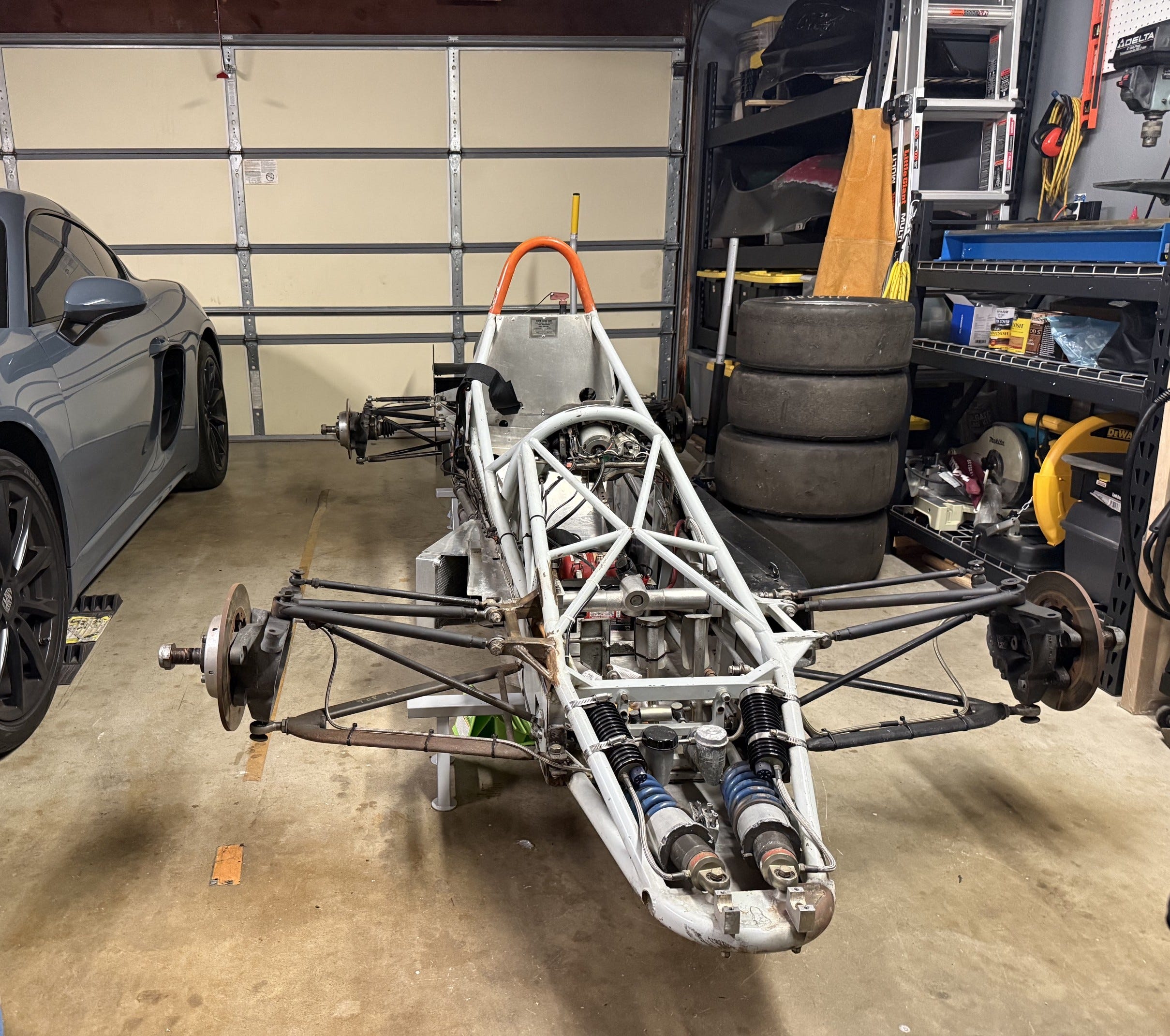
In the first article of this series, The Car I Probably Shouldn’t Have Bought, I wrote about purchasing a 1990 Elden Formula Continental/2000 and the challenge of learning from the ground up.
At the time, I assumed that meant learning about the car.
I imagined late nights in the garage, endless research, and a steep education in suspension geometry, chassis construction, engines, gearboxes, and race car setup. I expected the project to be difficult, occasionally frustrating, and ultimately rewarding.
What I didn’t expect was that the car would introduce me to an entire community.
At the end of that first article, I promised to answer the question: Where do you even begin with a 30-year-old race car? As it turns out, not where I expected.
The first article ended with more questions than answers. Beyond the chassis plate, there was very little documentation or history accompanying the car. Like most enthusiasts faced with an unfamiliar project, I started asking questions.
One of my first emails went to EldenRacing.com.
Not long afterward, I received a response from Chris Hampsheir, son of Elden designer Peter Hampsheir. Chris confirmed that my chassis, PRH29 #254/90/002, had originally been built as a Formula Renault before eventually finding its way to California. He explained that the Mk29 shared its core chassis design with the Mk27 Formula Ford and Mk28 Formula Ford 2000 cars, with differences largely centered around bodywork, engine, and gearbox configurations.
More importantly, he generously shared original drawings and technical information and offered to continue searching for additional material related to the car.
For a project that had arrived with virtually no history, corresponding with the family behind the marque itself felt surreal.
At about the same time, I posted a simple inquiry on the VARA Facebook page hoping to learn more about the car.
The response was overwhelming.
I expected a few technical suggestions.
Instead, I found myself welcomed into a community that has quietly preserved Formula Ford and Formula 2000 history for decades.
One of the first people to reach out was Paul Pfanner.
To motorsport enthusiasts, Paul needs little introduction. As the founder of RACER magazine, an award-winning journalist, editor, and storyteller, Paul has spent decades documenting the people, personalities, and history of motorsport. To me, he was someone whose work I had unknowingly followed and admired for years.
That’s why it came as such a surprise when he not only responded to my inquiry, but immediately made himself available to help.
What began as a conversation about an obscure race car quickly evolved into discussions about racing, storytelling, history, and the people who make this sport special.
Paul generously shared technical information, books, videos, and introductions. He helped connect pieces of my car’s history and introduced me to a world I had previously only observed from a distance.
What struck me most, however, wasn’t Paul’s knowledge.
It was his generosity.
At one point, after I asked if he would mind being mentioned in a future article, he jokingly welcomed me into the “Elden Brotherhood” and informed me that I would eventually need to learn the secret handshake.
More importantly, he shared a simple observation that has stayed with me ever since.
“The people are the best part of racing.”
I now understand exactly what he meant.
A few weeks later, Paul sent me a message that perfectly captured what I was beginning to experience:
“You have instantly attracted the A-team of SoCal racers, and it speaks volumes about why this Formula Ford/F2000 community has endured since the 1970s.”
One of those people is Graham Collins.
Graham volunteered to come to my home and inspect the car. Beyond decades of experience around vintage formula cars, Graham also serves as a technical inspector, giving him unique insight into what it actually takes to get a car safely through technical inspection and onto the track.
After carefully looking over the Elden, Graham gave me reassurance that I didn’t realize I needed.
“You’ve got a good base to start with. You just need to make the car safe.”
It was a simple statement, but an important one.
Until then, the project still felt slightly overwhelming. Hearing someone with Graham’s experience validate the car, and the possibility of getting it back on track, changed the way I viewed the entire undertaking.
During his visit, Graham invited me to visit his shop and I enthusiastically took him up on the offer.
What I thought would be a brief visit turned into something much more meaningful.
The shop itself carries decades of history. It was operated by Graham’s father, John Collins, for more than forty years. John hired by Ken Miles to work on the Cobra and Cobra Daytona coupe. Ultimately Caroll Shelby assigned him as a head mechanic and crew chief for the Le Mans-winning Ford GT40 program and then on to the legendary GT40 Mk IV.
During one visit, Graham graciously pulled out his father’s photo albums from that era and shared it with me.
Looking through photographs featuring Shelby and members of the GT40 team transformed names I had only encountered in books, magazines, and documentaries into real people.
History suddenly felt much closer.
Then Graham invited me to help.
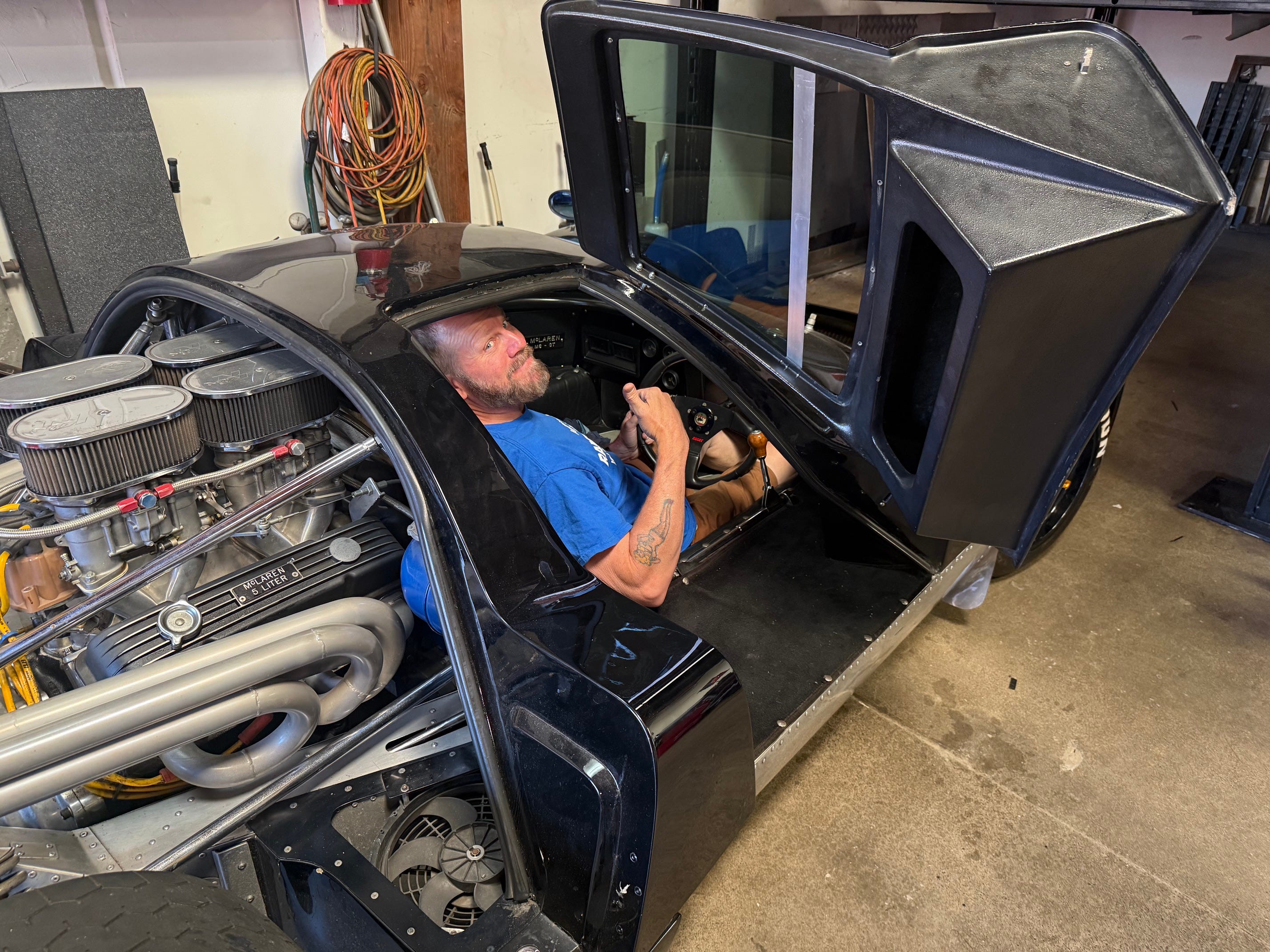
My first opportunity involved assisting (and I use that term lightly) with an incredible McLaren M-12.
More recently, I had the opportunity to help with the restoration of an original Lotus 23 chassis that had previously suffered significant crash damage.
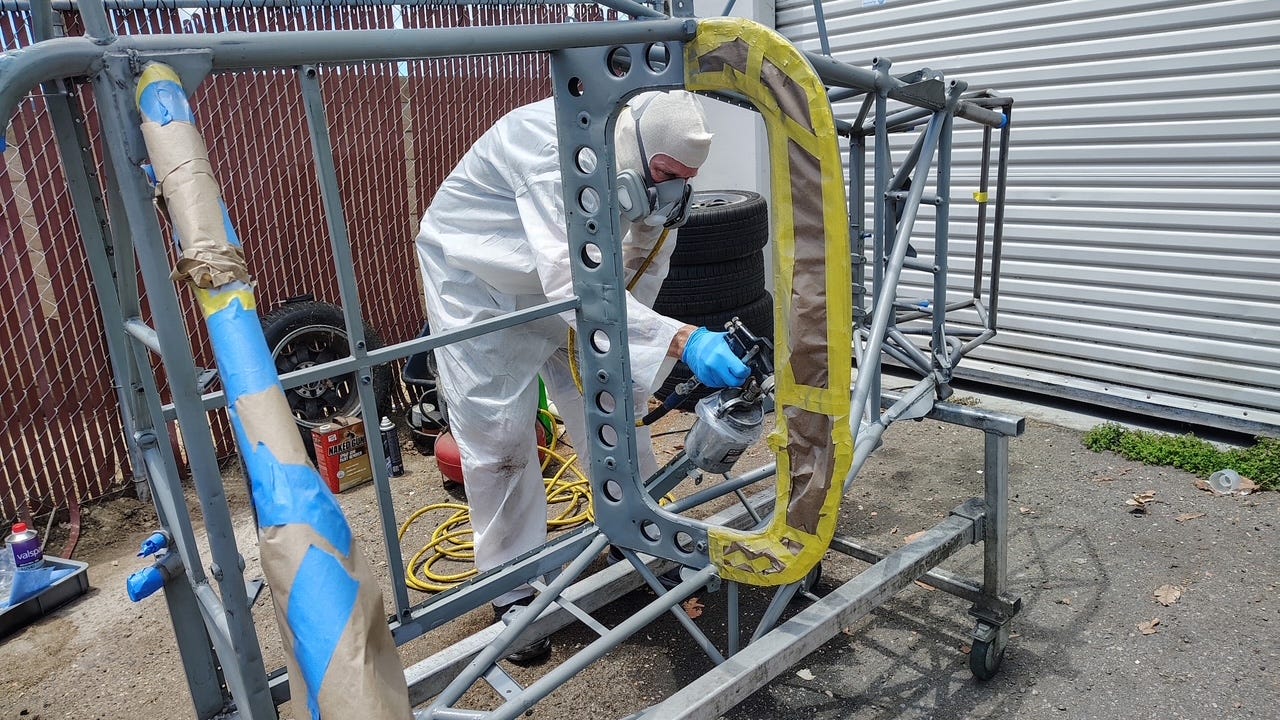
Before a drop of paint could be sprayed, the chassis required days of careful preparation. I spent much of that time wire-brushing, sanding, cleaning, and preparing the repaired frame.
When the chassis was finally ready, Phil, who has worked along side Graham for many years, patiently walked me through setting up the spray gun and, under his close supervision, entrusted me with spraying paint on the frame. Like many first attempts at learning a skill, the results were less than perfect, but the experience was invaluable. It gave me an even greater appreciation for the craftsmanship involved and reinforced just how much there is to learn.
For someone whose own race car was still sitting largely untouched in the garage, it felt like a remarkable privilege.
Both Graham and Phil have been incredibly generous with their time, knowledge, and patience. More importantly, they have been welcoming.
As Graham continues rebuilding the Lotus, I hope to spend many more weekends helping where I can and learning as much as possible. The opportunity to absorb decades of experience simply isn’t something that can be replicated through YouTube videos, manuals, or internet forums.
The generosity hasn’t stopped there.
Graham has offered to guide me through the Elden restoration and has already begun connecting me with specialists who understand these cars far better than I do. Through him, I’ll have access to people familiar with my engine, gearbox experts, professional welders, and specialists capable of inspecting the chassis and suspension components for cracks and hidden damage.
For someone entering the world of vintage formula cars for the first time, those introductions are invaluable.
As my understanding of the car grew, so did the number of people willing to help.
One of those people was Larry Haynes, who helps maintain the Elden Register and races Eldens in VARA competition. Larry initially believed my car might be another Elden that had appeared on Bring a Trailer several years earlier and immediately began helping investigate its provenance.
Although the car ultimately proved to be different, Larry’s willingness to help further reinforced what I was already beginning to discover: this community genuinely cares about preserving these cars and their history.
Larry also offered to add my chassis to the Elden Register, helping preserve another small piece of Elden history for future enthusiasts.
Ironically, my own Elden has seen less progress than I originally planned.
Work travel, family obligations, and life in general have repeatedly delayed the project. I also made a promise to my wife that I would finally complete the custom kitchen cart I started building a year ago before fully diving into the race car.
She occasionally reminds me of that promise.
Still, progress is finally happening.
The garage is organized. The Elden now sits on chassis stands. The wheels are off. The brakes are coming apart. For the first time since bringing the car home, I feel like the restoration has truly begun.
But somewhere along the way, I realized this project was no longer just about restoring an old race car.
What started as a simple attempt to return a forgotten Formula 2000 to the track has become an introduction to an entire world of racers, mechanics, historians, craftsmen, and storytellers who continue to preserve motorsport history one car, one conversation, and one friendship at a time.
The deeper I dig into the car’s history, the more I realize that this isn’t simply a race car project.
Based on conversations with longtime Elden owners and historians, the car appears to be one of only two examples of its type remaining in North America. That realization has changed my thinking.
My goal is no longer just to get the car running.
I want to restore it properly.
I want to understand it.
I want to preserve as much of its history and character as possible.
And before I ever point it toward Turn One, I’d like to make sure I’ve done my homework as a driver as well. That means simulator time, training, advice from people who know these cars far better than I do, and hopefully a healthy dose of humility.
After all, it would be a shame to spend years bringing the Elden back to life only to undo all that work in a single enthusiastic corner entry.
For now, the restoration continues.
But thanks to the people I’ve met along the way, the journey has already become far more rewarding than I ever expected.
The Elden may have brought me to the door.
The people are what convinced me to walk through it.
This article is part of an ongoing series in The Grand Touring Journal following the restoration and eventual return to the track of a rare 1990 Elden Formula Continental/2000. Future installments will explore the restoration itself, the remarkable people preserving its history, and the lessons learned along the way.