
By Sion Dettra
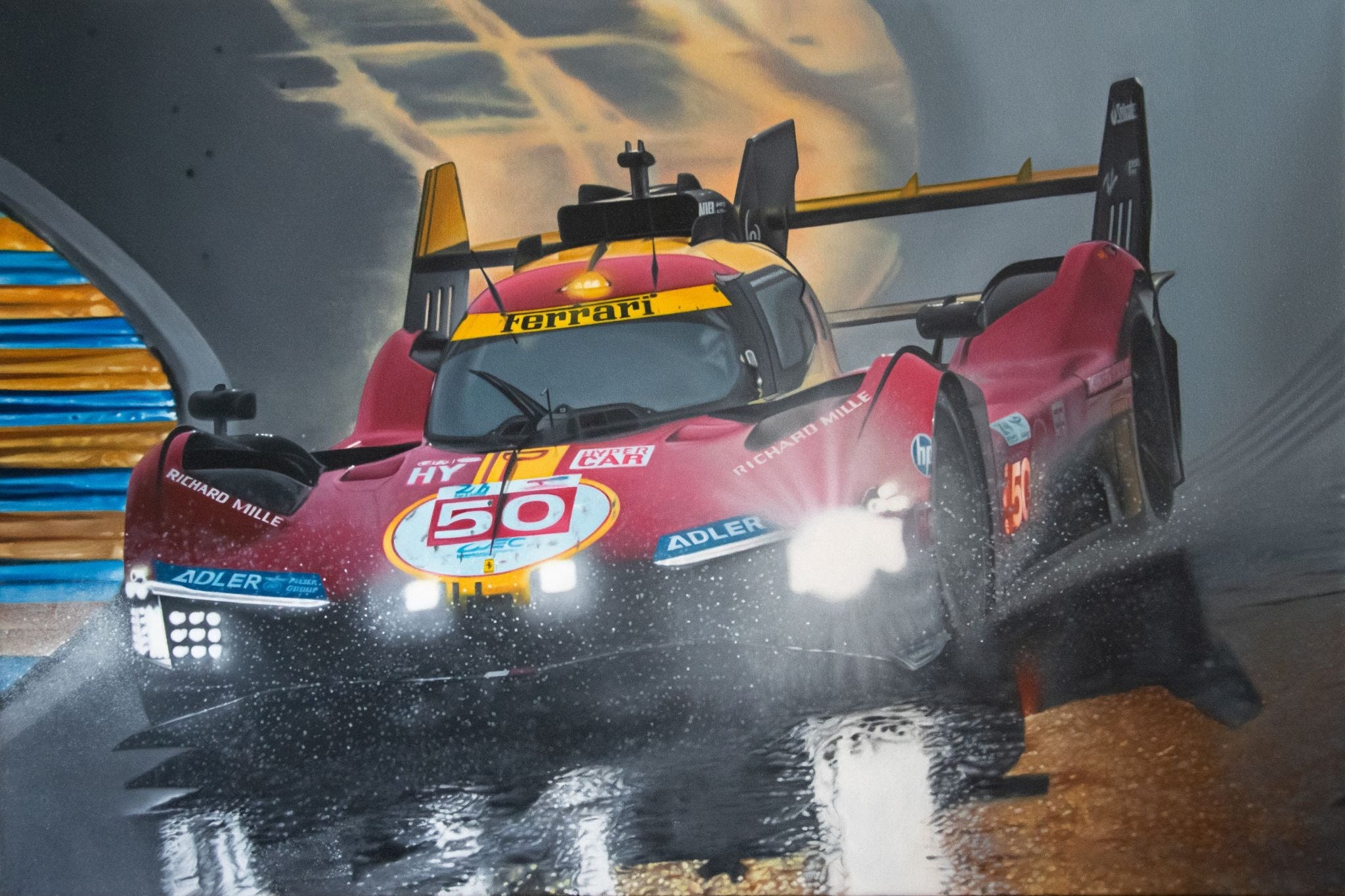
The first time I saw Breaking Through Rain in person, my wife and I were in Maranello, Italy. Most definitely an appropriate place for it.
We were there for the Italian Grand Prix and had set aside a day to take in the automotive history of Modena and Maranello. I happened to connect with Italian artist Simone Salvadori on LinkedIn just days before our departure from Los Angeles, resulting in a meet-up with him and his wife, Barbara, in Ferrari’s hometown. What began as an online introduction turned into an afternoon together, talking about cars, racing and art over wine and a charcuterie board at the café inside the Ferrari Museum.
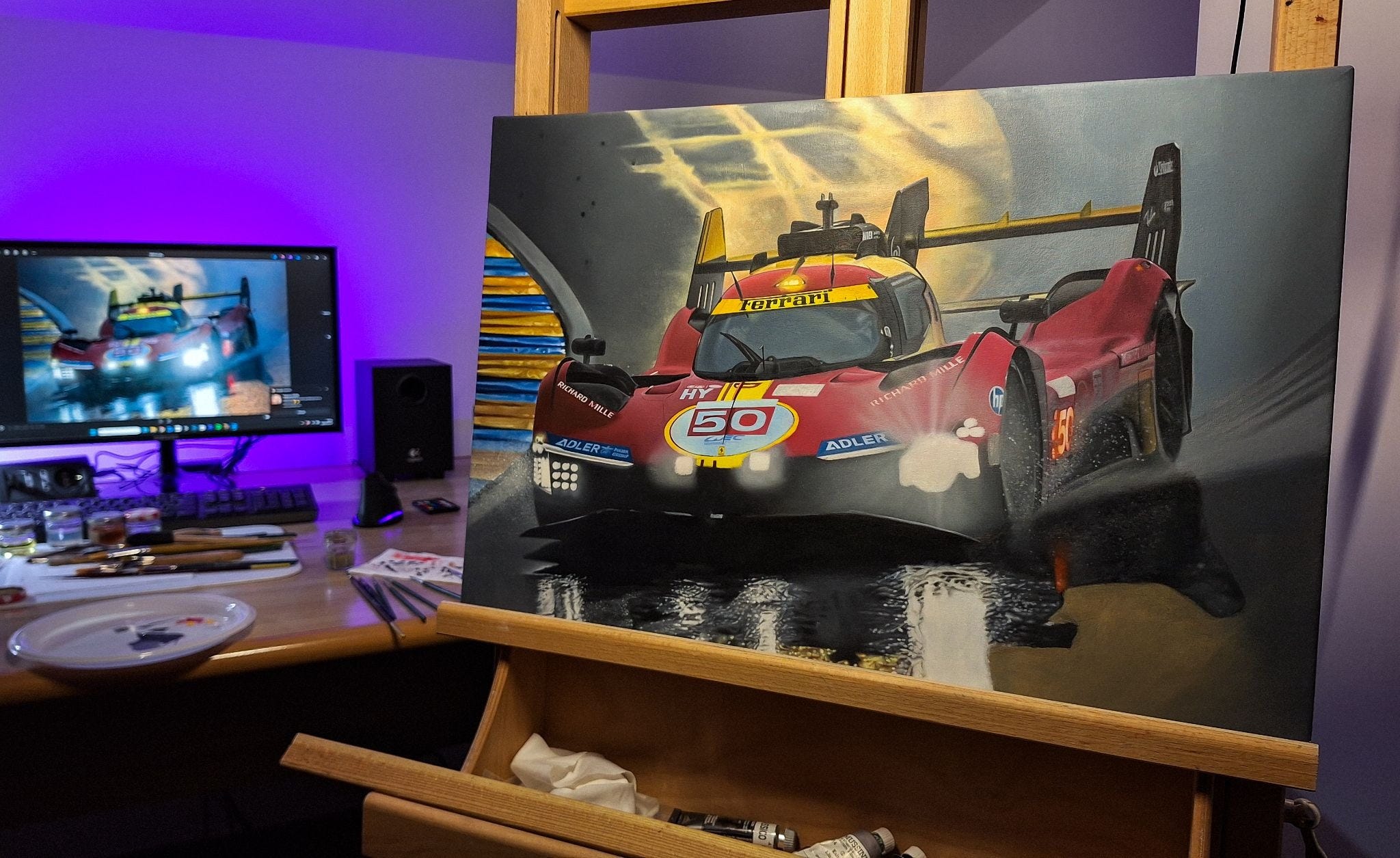
Simone could have brought one of several incredible examples of his work, but the one painting he decided to share was special. It depicted a Ferrari 499P at Le Mans, charging through the darkness and rain, its headlights cutting through the spray while reflections fractured across the wet circuit.
I had the privilege of being the first person to see the painting in person.
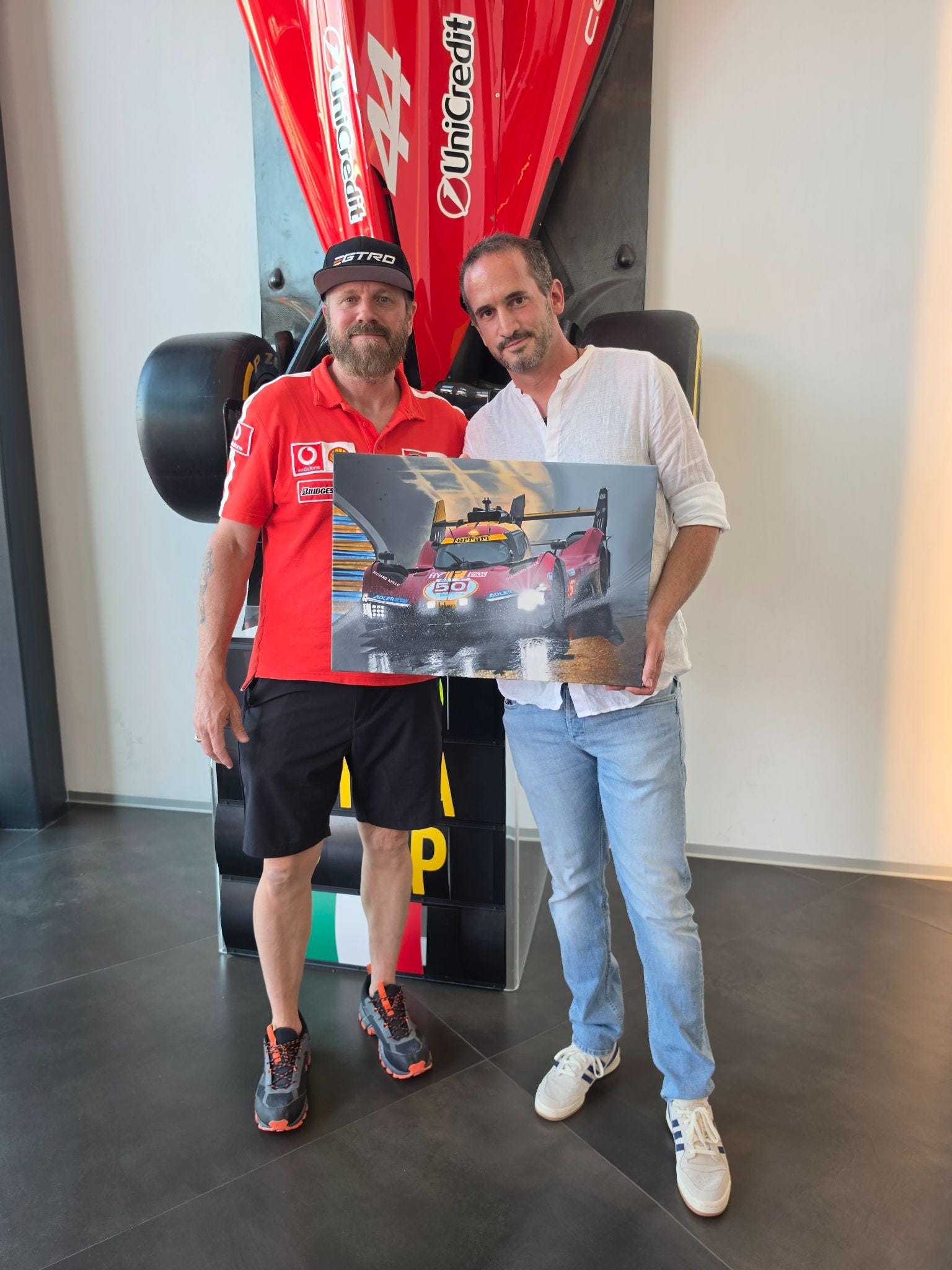
At first glance, the Ferrari commands your attention. Look longer, though, and you realize, there’s so much more to it, even apparent to someone artistically challenged like me. There is rain, spray, reflected light and darkness. The edges of the scene seem to dissolve into movement. It’s so much more than a portrait of a Ferrari race car.
That distinction is important because it gets to the heart of what Simone is trying to accomplish with Hyperline, the artistic identity he is still in the process of creating.
“I don’t want someone looking at one of my paintings to simply feel that they are looking at a beautiful automobile,” he told me. “I want them, for a moment, to feel as though they are actually inside that scene.”
For Simone, the automobile is the subject. But the experience is the story.
Cars and Art
Simone was born and raised in Bolzano, in South Tyrol in northern Italy. Art and automobiles entered his life so early that he can’t really separate one from the other.
Some of his first toys were Bburago Ferrari models and before he fully understood what Ferrari represented in the automotive world, he was already fascinated by the shapes and colors of the cars and drawing them.
“I couldn’t say with certainty which came first,” he says of his love of cars and his love of art, “because in my memories they have always gone together.”
He attended an art-focused school, developing the fundamentals of drawing and visual representation. His professional life would eventually take him in other directions, but drawing and creativity remained with him. Oil painting came later, largely through self-directed study, practice and experimentation. Motorsport was developing alongside the art.
Simone grew up watching Formula One during the 1990s and early 2000s. Ayrton Senna was one of the drivers who made him fall in love with motorsport. He also remembers fondly the Ferrari pairings of Jean Alesi and Gerhard Berger, followed by Michael Schumacher and Rubens Barrichello.
One race remains particularly vivid: the 1998 Hungarian Grand Prix, when Schumacher and Ferrari used an aggressive three-stop strategy to overturn the race. For Simone, it represented everything that made racing compelling: “speed, precision, strategy and the ability to continually push beyond the limit.”
If there is one Formula One car that represents the era for him, it is Schumacher’s Ferrari F2004. “Aggressive, elegant and instantly recognizable,” is how he describes it. Those same qualities, shape, light, emotion and identity, would eventually become central to his art.
But the moment when art and motorsport truly began to converge didn’t happen while Simone was sitting in front of a television, it happened at a track.
The Weekend at Misano
In 2022, Simone met the owner of a Ferrari 488 GT3 competing with AF Corse. After seeing examples of Simone’s work, the owner was so impressed, he invited Simone to attend a race at Misano. He even suggested the possibility of Simone attending future GT3 weekends with a space in the paddock where he could draw and paint. The collaboration never materialized, but something more important did. Simone experienced racing differently.
“Seeing those racing cars up close, almost physically feeling the sound of the engines, sensing the tension inside the garage during the race and being able to observe what normally remains hidden in the paddock completely changed the way I experienced motorsport.”
Until then, racing cars had been potential subjects. At Misano, they became part of something larger.
“I no longer saw simply automobiles to paint,” he says. “I saw a world made of speed, light, tension, people, noise and atmosphere that I wanted to try to tell through painting.”
That sentence may be the best explanation of Hyperline.
Painting the Experience
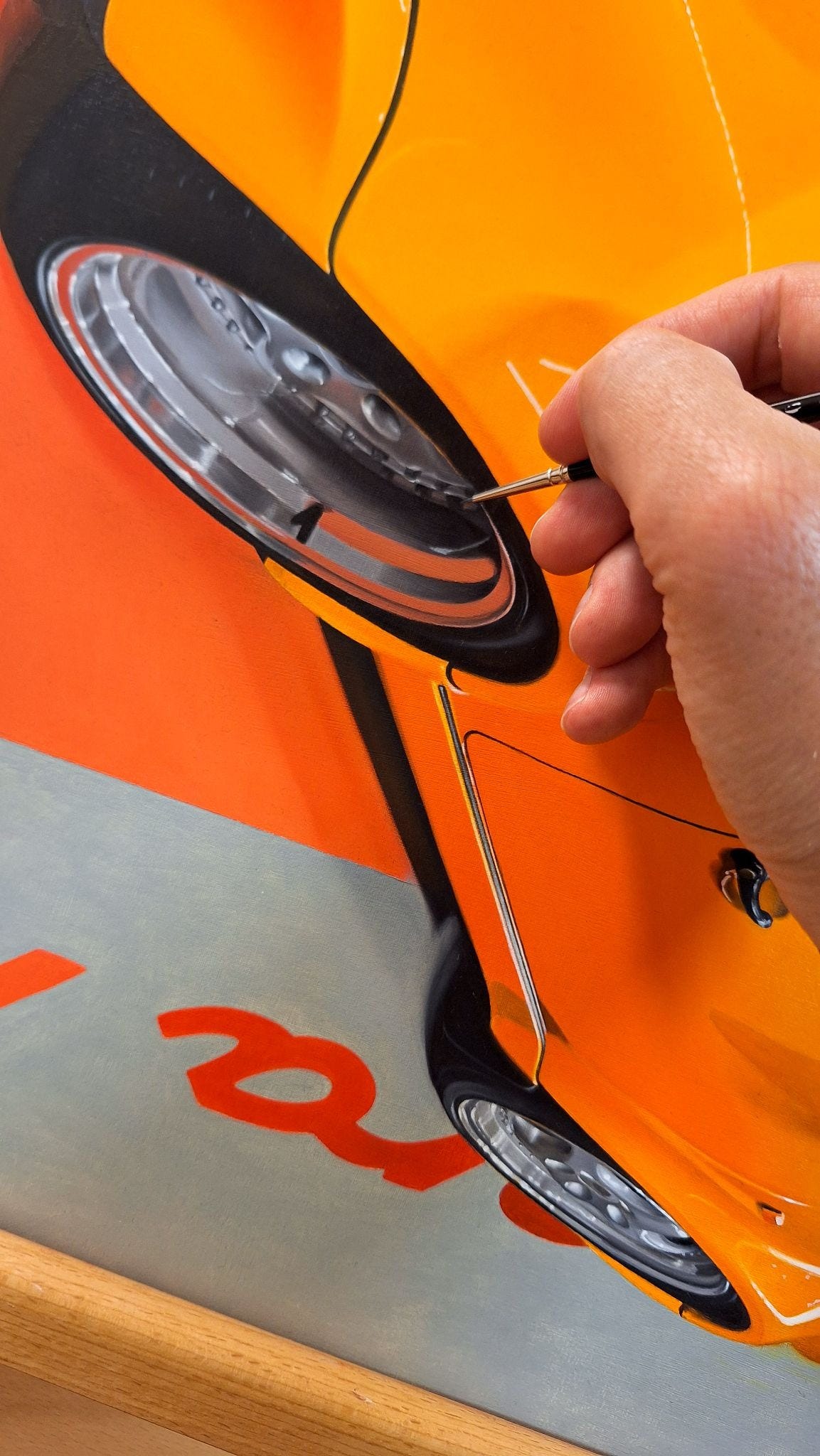
Simone describes his style as highly detailed realism approaching hyperrealism, but the distinction matters to him. Technical precision isn’t the ultimate objective. The goal is to make the automobile feel almost physically present while still communicating the emotion.
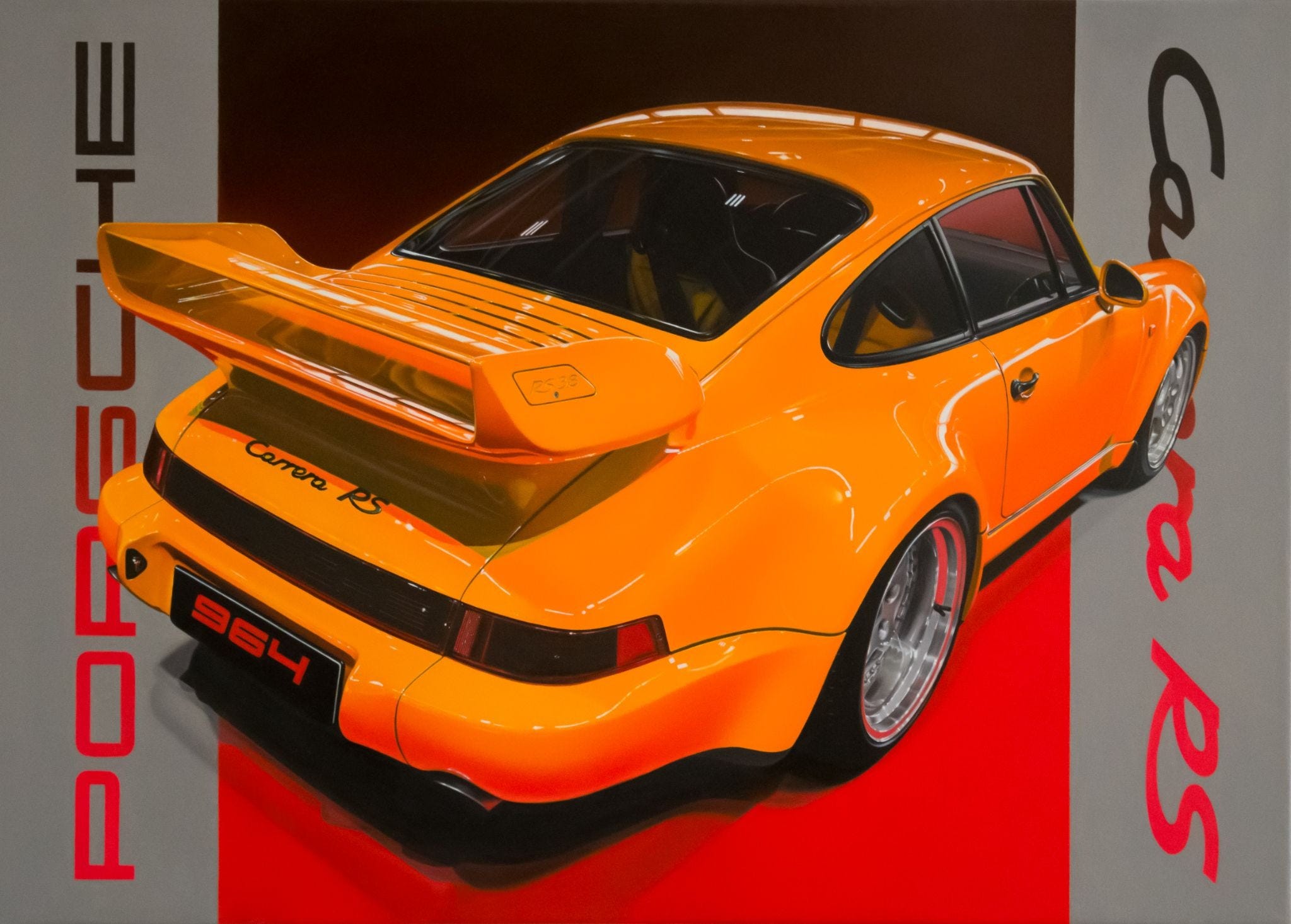
That is why light appears again and again when Simone enthusiastically explains his work. Reflections across bodywork and by the way surfaces change under different conditions are a significant focus. In racing scenes it translates to rain, darkness, circuit lighting and movement.
Some portions of a painting may be rendered with extraordinary precision, while other areas are deliberately freer, almost abstract water, reflections and light dissolving around a carefully defined automobile. He calls it a balance between “control and atmosphere.”
There is an interesting parallel with racing itself. A race car is an exercise in precision, engineered to operate at the limit. Yet racing takes place in an environment that cannot be completely controlled. Weather, light and grip change. Drivers make mistakes. Mechanical components fail.
In Breaking Through Rain, Simone found a way to put those two worlds on the same canvas.
Breaking Through Rain
The Ferrari 499P was an obvious subject for Simone. The car’s shape, livery and endurance-racing success interested him, but producing an accurate portrait wasn’t the goal.
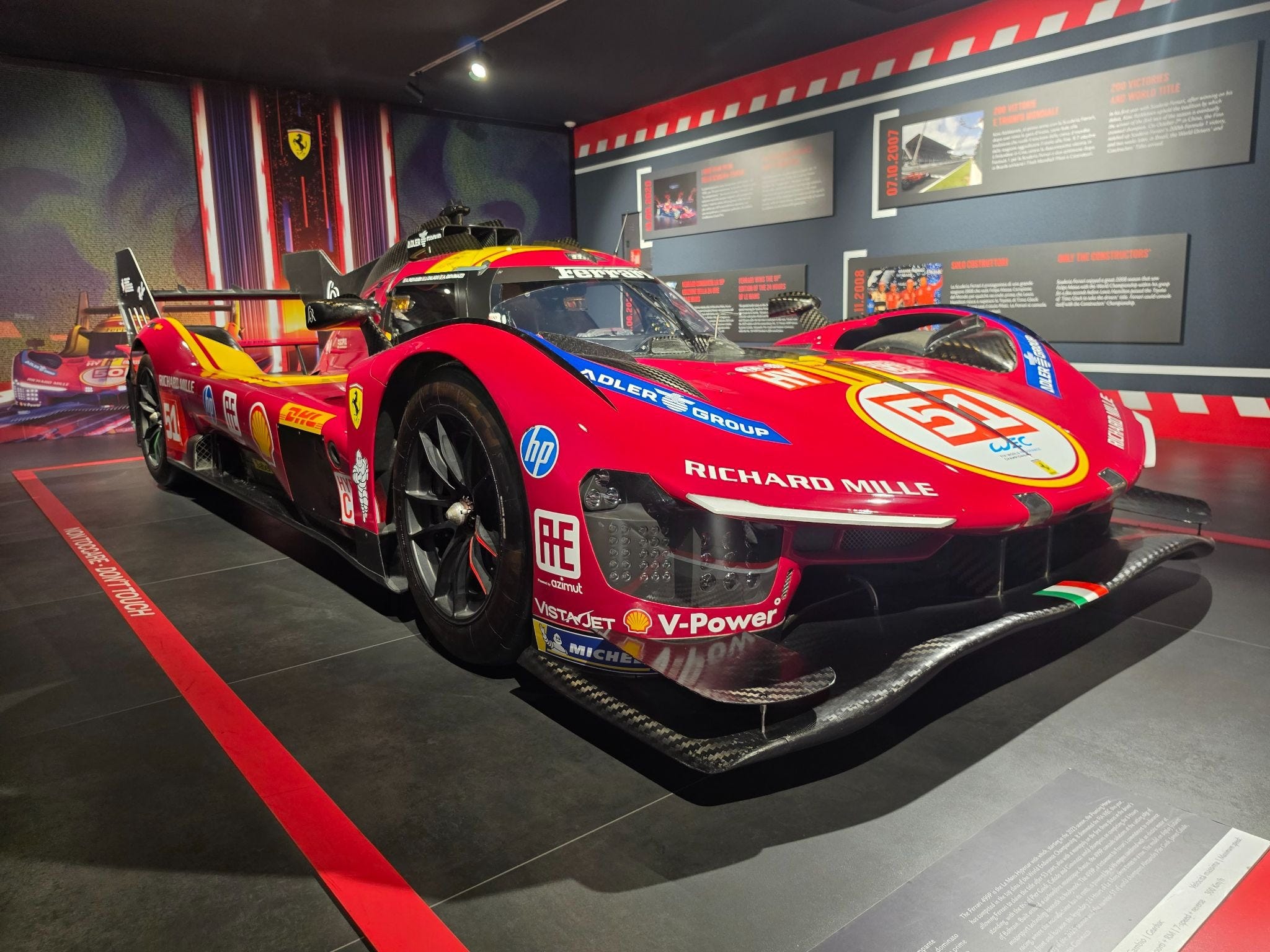
“I wanted to tell the story of what, for me, makes an endurance race fascinating: the night, fatigue, speed, difficult conditions and that almost unreal atmosphere created when the lights of the cars and circuit meet the rain and wet asphalt.”
The environment became nearly as important as the car. Water obscures parts of the Ferrari while revealing others. Reflections stretch across the pavement. Light scatters against the wet surface. Spray breaks apart the otherwise precise lines of the machine.
“The car remains the principal subject,” Simone explains, “but around it is a kind of chaos made of light, movement and water.”
The reflections on the wet asphalt and the spray thrown from the tires were among the most difficult portions of the painting. Many of the individual droplets were painted one at a time. Simone worked with contrast, transparency and deliberately blurred areas to create depth without allowing the rain to overwhelm the Ferrari. The result is the contrast he sought: a machine designed for precision operating inside an environment that is inherently unpredictable.
“The rain isn’t simply an atmospheric element,” he says. “It is what allows me to make the speed and tension of the scene visible.”
Stand close to the painting and the individual elements reveal themselves. Step away and they merge. The 499P seems to emerge through the water, and that experience is difficult to appreciate on a screen, and it was certainly different holding it in my hands in Maranello.
For Simone, Breaking Through Rain became more than another painting. It was the piece that clarified where he wanted his work to go.
“I realized this was the path I wanted to explore: not limiting myself to representing automobiles, but trying to tell the experience and emotion of motorsport.”
Freezing Something That Doesn’t Stand Still
Motorsport presents an unusual challenge for a fine art painter. Photography can freeze a race car with extraordinary precision and modern cameras can capture details that the human eye barely registers as a car flashes past; so why paint it? Simone’s answer may be the central idea behind his work.
“When we see a racing car in person, the experience lasts only a few seconds: it arrives, passes in front of us and disappears. Through painting, I try in some way to stop that instant and allow the viewer to remain inside it a little longer.”
A photograph records what existed in front of the lens for a fraction of a second. Painting allows Simone to interpret that fraction of a second. He can exaggerate a reflection, alter the light, deepen a shadow or intensify the rain. The objective isn’t necessarily to reproduce exactly what a camera recorded. It is to reconstruct what the moment felt like.
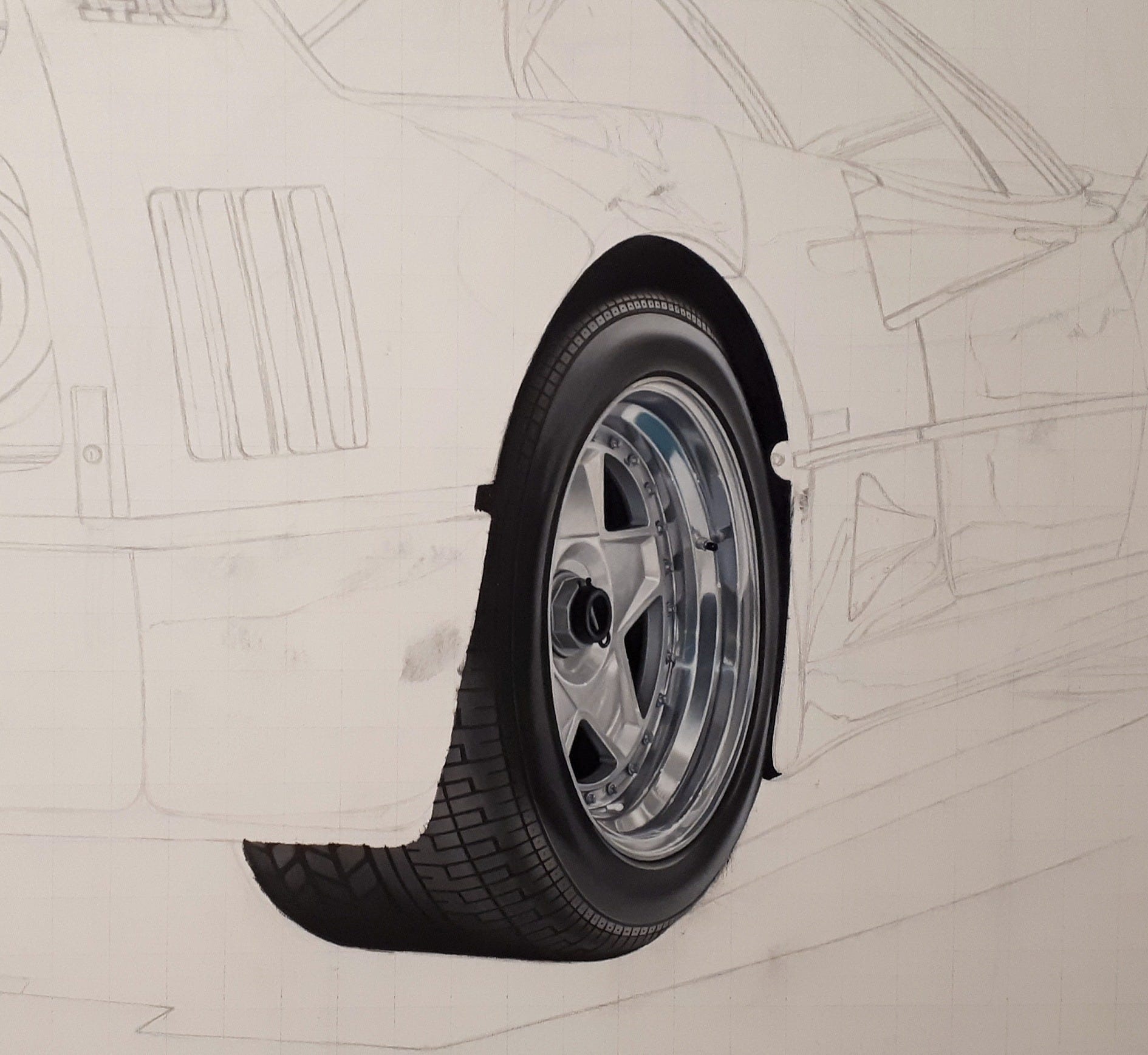
“A painting can condense memory, emotion and interpretation into that same image,” he says.
That explains why his paintings can feel cinematic. Simone cites James Mangold’s Ford v Ferrari and Ron Howard’s Rush as influences because the cars are only part of what makes their racing scenes compelling. There is tension, risk, rivalry, noise and people. Simone wants those things on the canvas too.
The Pull of Ferrari
It is difficult to tell Simone’s story without returning to Ferrari. His earliest memories include those Bburago Ferrari models. His formative racing years included Schumacher. The F40 has been his dream car since childhood. His first serious motorsport painting depicts a 499P. And when we met, appropriately enough, it was in Maranello.
For Simone, the connection goes beyond racing success. “As an Italian, Ferrari represents for me a symbol of pride, excellence and identity,” he says. “It is a very particular combination of power and elegance, concentrated within an unmistakable design.”
The F40 remains especially important to him, and he has captured it in a painting titled Rosso Assoluto. What interests him artistically is the ability of certain automobiles to communicate their identity without needing to show the entire car.
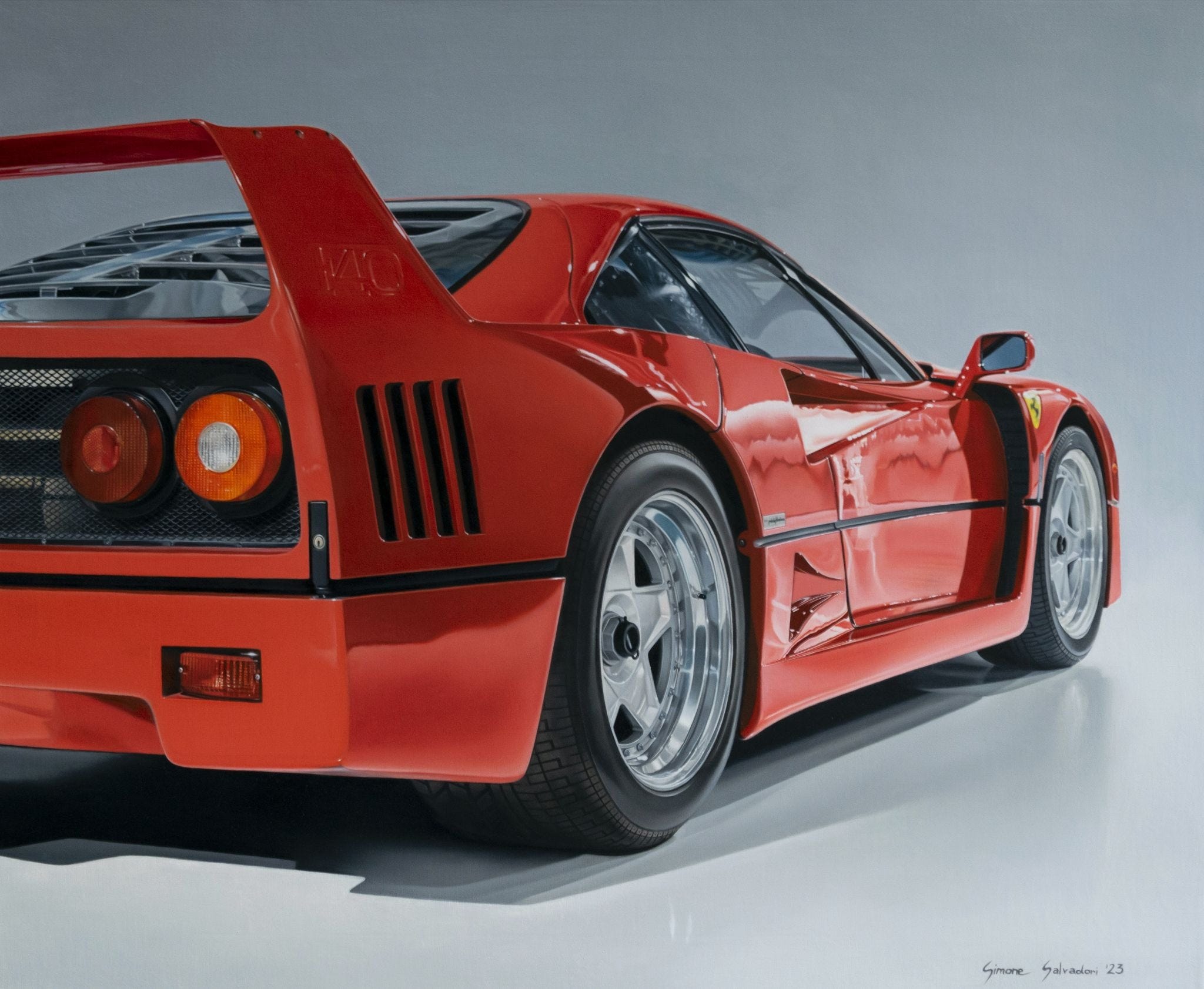
“A Ferrari doesn’t need to be explained,” he says. “Often a line, a detail, a reflection or a portion of the bodywork is enough to immediately understand what it is.”
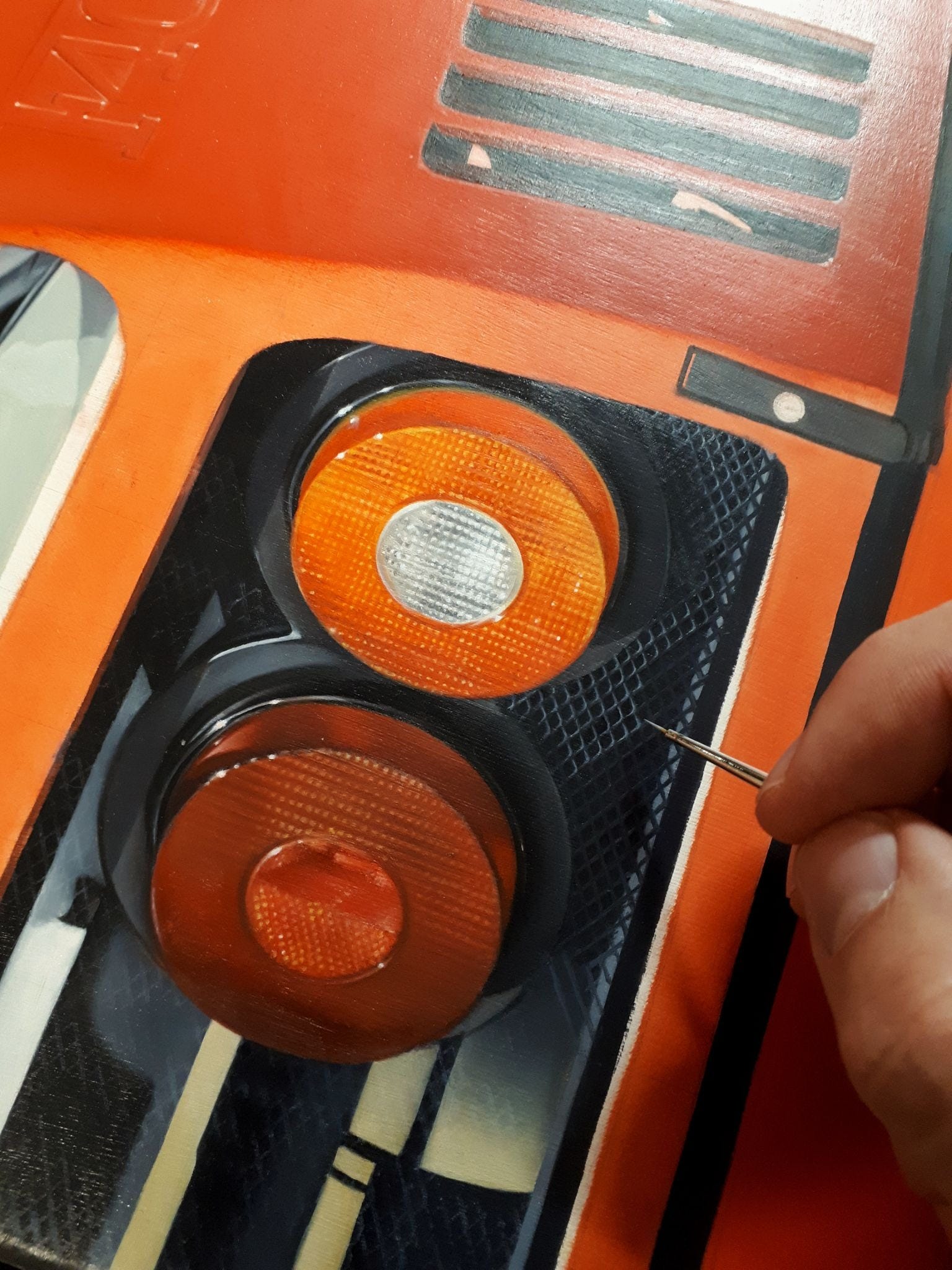
That idea is influencing his current work as Simone is painting a Ferrari 250 GTO, but rather than depict the entire automobile, he chose a close view of the hood, headlight and three characteristic air intakes. The fragment is enough.
Sculptures in Motion
Although the 499P was Simone’s first serious racing subject in oil, his interests extend much further back into racing history.
Historic racing cars fascinate him because their shapes feel almost sculptural. He mentions the Mercedes-Benz W196 R Stromlinienwagen, Ferrari 250 GTO, Porsche 917 and Ferrari 330 P4.
That fascination with automotive form isn’t limited to race cars. In his work such as Ali d’Argento, the automobile itself becomes the study, with light, reflection and bodywork providing the movement.
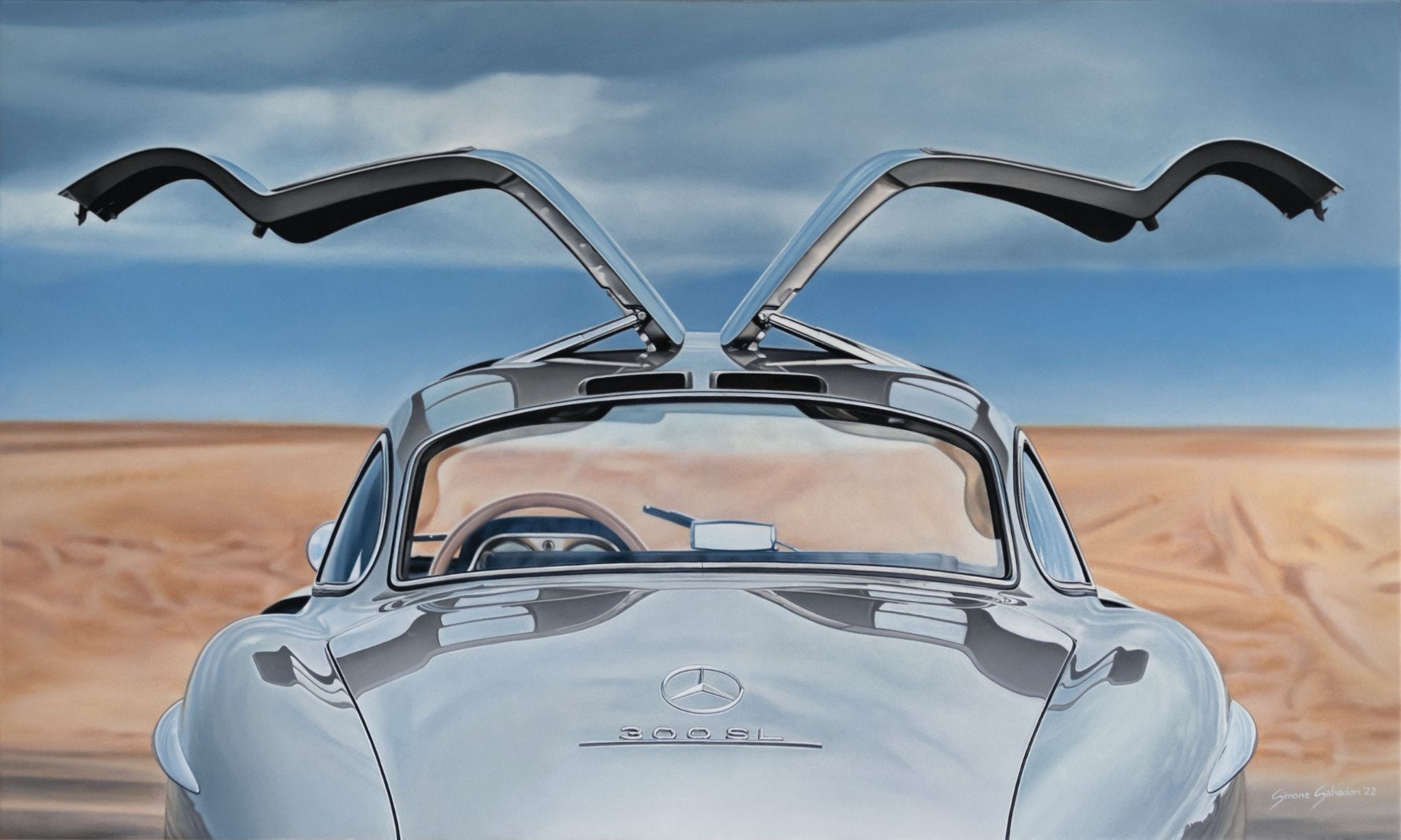
Their forms, he says, are “simple, flowing and unmistakable.” Light moves differently across them. A fender, roofline or tail can identify the entire car.
If Simone could travel back to any race in history, he would choose the 1967 24 Hours of Le Mans. He imagines standing somewhere along the Circuit de la Sarthe watching a Ferrari 330 P4 pass through the changing stages of an endurance race: daylight, sunset, darkness and finally dawn. Predictably, he would be most interested in the night. That is when, as Simone puts it, motorsport becomes “almost cinematic.”
Just the Beginning
There is something refreshing about Simone’s view of Hyperline because he doesn’t speak as though the destination has already been determined. It’s quite the opposite. “I feel I am still at the beginning of this journey,” he says.
His route to automotive fine art wasn’t linear or carefully planned, it grew through years of drawing, work, different experiences and a lifelong fascination with cars. At times, people questioned his decision to concentrate so heavily on automotive subjects. Coming from a part of the world with such a deep tradition of classical art, there was no shortage of more conventional subjects he might have pursued. Landscapes, still lifes and other subjects might appeal to a broader audience, and Simone understood that argument. Cars, however, fascinated him since childhood, and they were the subjects that drove his passion for painting.
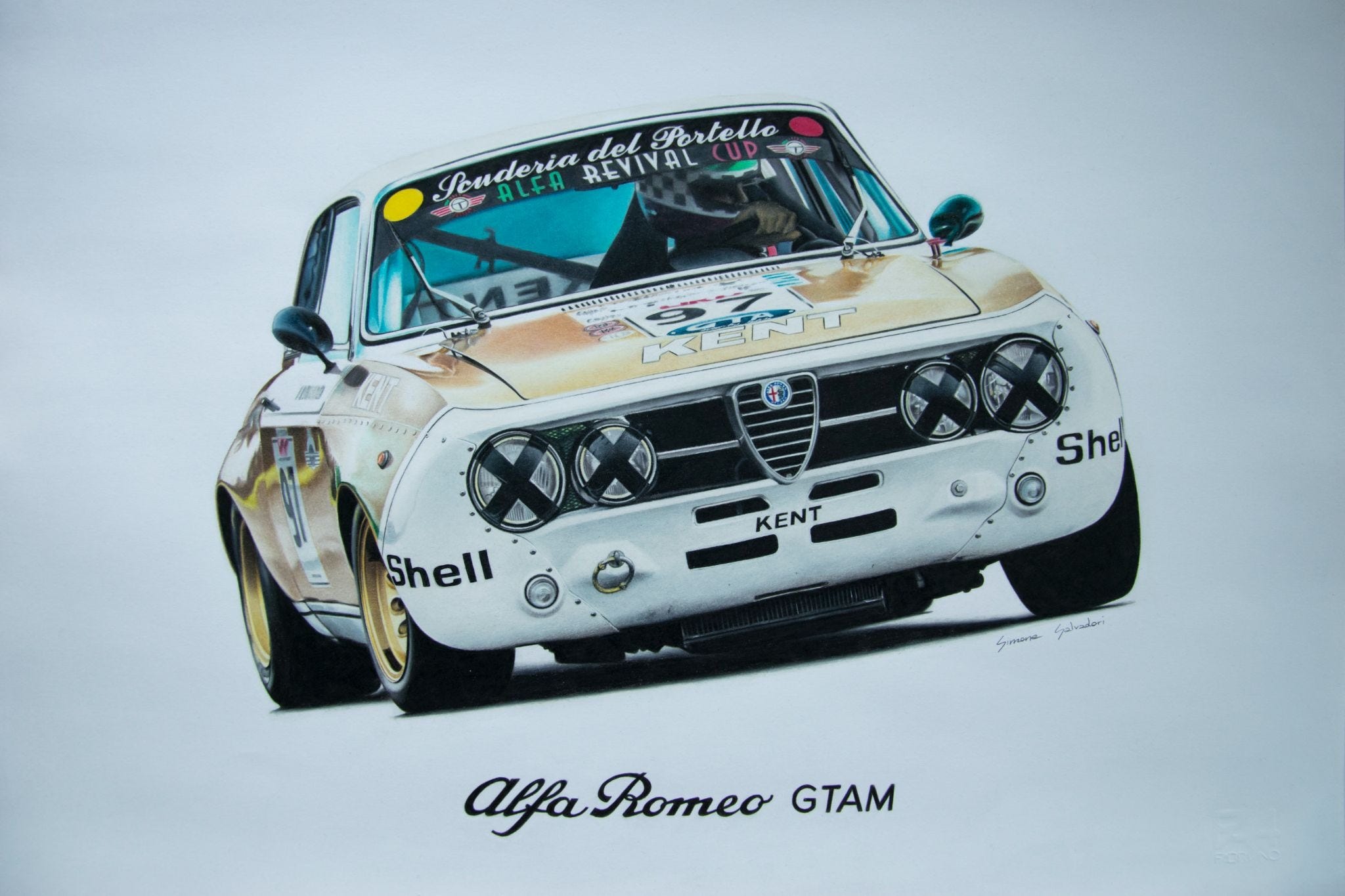
“I realized that I didn’t simply want to paint what might be more easily appreciated by a wider audience,” he says. “I wanted to truly combine my passion for automobiles with my passion for art and try to build something that felt deeply my own.”
That something is Hyperline. Simone is building relationships with motorsport photographers and hopes eventually to spend more time inside the world he paints; to enter paddocks, meet drivers, teams and photographers, and gather his own images and experiences. He wants future paintings to emerge from those encounters.
Perhaps that is why Breaking Through Rain feels so appropriate. The painting isn’t about a Ferrari sitting still. It depicts the machine moving toward something we cannot see, surrounded by noise and uncertainty, with only the next stretch of road illuminated.
Hyperline is still moving in much the same way. Simone doesn’t know exactly where it will take him, but he knows what he wants to capture along the way.
“I don’t think what I want to portray is simply automobiles,” he says. “I want to portray everything that revolves around them: the memories, the noise, the light, the tension, the people and the emotions that allow a machine to mean much more than simply an object.”
For someone who has spent a lifetime around cars, that may be the most compelling thing about Simone Salvadori’s work.
The automobile is where the eye goes first, but the feeling and emotion stay.